
Phantom.
Heavy lift for the contested fight.
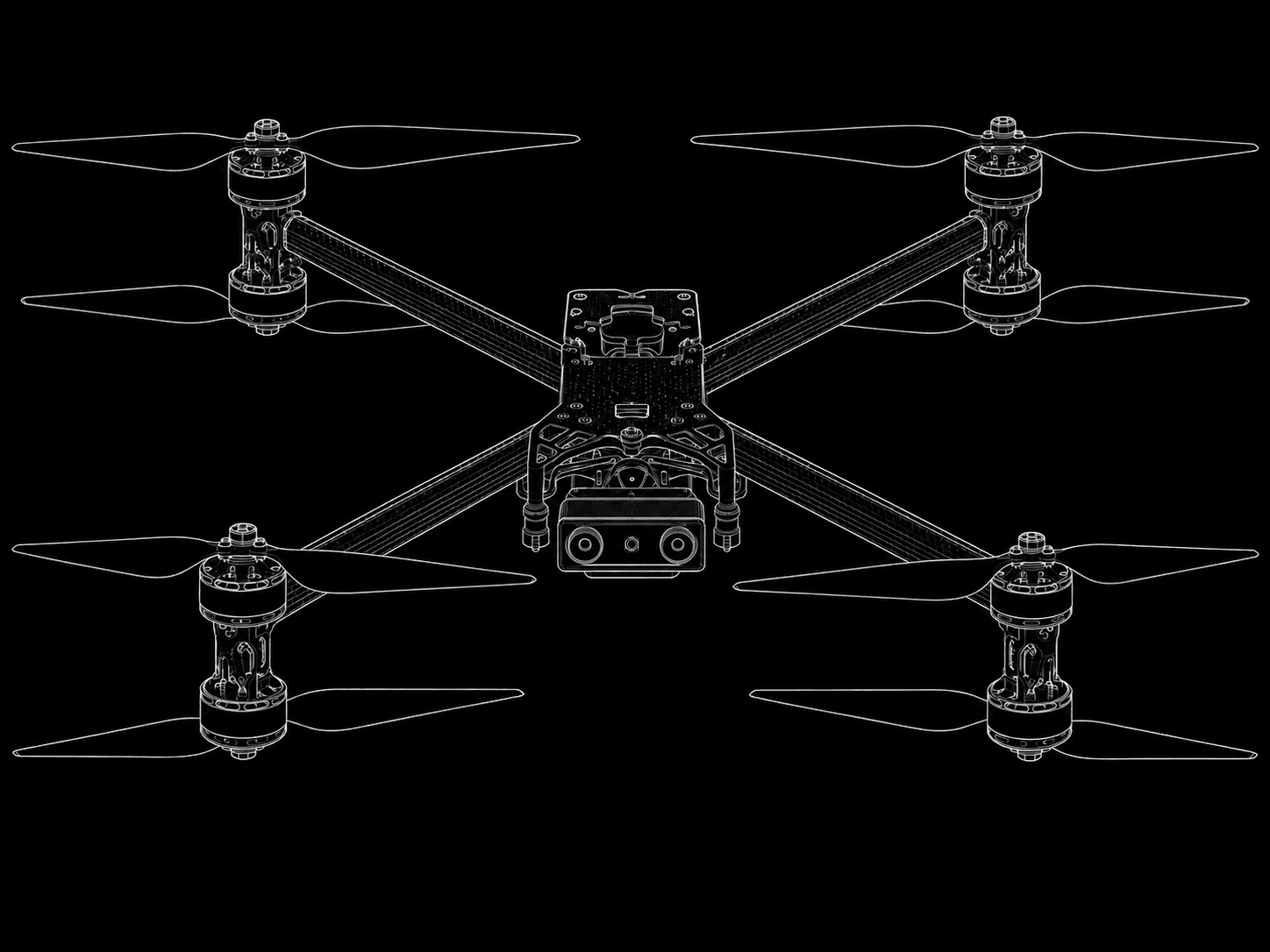
Built for the space between.
Four side-folding arms collapse alongside the central chassis. Front and rear arms fold into offset parallel lanes, so the coaxial motor assemblies stay side by side rather than stacking vertically. Folding propellers remain attached and stow inside a padded sleeve.
The mission battery can stay installed for rapid deployment or be carried separately to lighten the operator's load. Deployment objective: under two minutes.
- ·Dedicated drone backpack
- ·External rucksack frame
- ·Semi-rigid soft-shell sleeve
- ·Compact hard case
- ·Vehicle or field equipment rack
A one-person-carried autonomous aircraft capable of transporting mission equipment that compact ISR drones cannot carry.
Carry, place, deliver, deploy, recover.
- ·Medical & emergency supplies
- ·Communications relay equipment
- ·RF & networking payloads
- ·EO/IR & mapping sensors
- ·Deployable mesh-network nodes
- ·UWB anchors & nav beacons
- ·Environmental sensors
- ·Batteries & power modules
- ·Search-and-rescue equipment
- ·Custom government & research
A standardized underside interface lets payloads be carried separately and installed in the field, changed without redesigning the aircraft.
Phantom isn't limited to dropping a payload and returning. For comms and sensor missions it can persist on station without burning energy in continuous hover.
- 01Carry a payload to elevated or inaccessible terrain
- 02Autonomously land or dock
- 03Shut down the propulsion system
- 04Operate the payload from onboard or dedicated power
- 05Relaunch for recovery or repositioning
Brains, avionics, and propulsion.
- ·High-level mission tasking
- ·Autonomous waypoint & route execution
- ·Obstacle detection
- ·Collision-prevention velocity limiting
- ·GPS-degraded navigation & visual odometry
- ·Onboard perception
- ·Mission replanning
- ·Automated landing
- ·Health & power monitoring
- ·Multi-vehicle coordination
- ·TAK-compatible command & SA
How the wing thinks. See the approach →
- ·Eight motors in a four-arm footprint
- ·Higher lift without an eight-arm frame
- ·Compact folding geometry
- ·Improved propulsion redundancy
- ·Greater payload margin
- ·Independent motor control
- ·Replaceable arm-end propulsion modules
DEV ARCHITECTURE · 22" FOLDING PROPS · 12S
Designed to support future communications, navigation, sensing, and payload upgrades, with qualified flight-control and edge-compute components, modular by intent.
Configure to the mission.
- ·Reduced payload
- ·Larger mission battery
- ·Longer flight duration
- ·Land-and-operate capable
- ·Balanced battery + payload
- ·Useful operational range
- ·Normal maneuver & reserve margins
- ·Reduced battery capacity
- ·Increased mission payload
- ·Shorter flight duration
- ·Higher structural & propulsion loading
Phantom is in active development. Initial work focuses on:
- ▸Folding chassis design
- ▸Coaxial propulsion validation
- ▸Battery & endurance testing
- ▸Structural load testing
- ▸Payload-interface development
- ▸Autonomy integration
- ▸Communications-relay demonstrations
- ▸Medical & sensor payload demonstrations
Learn how GhostForge supports product development, integration, and test as an internal capability in the GhostForge overview. For evaluation or development partnerships, get in touch.